Your cart is currently empty!
Theoretical Cost-Efficient Bio-Quantum-Supercomputer
The human brain remains the most sophisticated computational architecture in the known universe, yet we treat it as a biological curiosity rather than a blueprint for the future of processing.
I am informed of those who imagine such wetware that can beat even Tensor Processing Unit(TPU) standards.
While current ‘DishBrain’ experiments have mastered basic tasks like Pong, we are barely scratching the surface of what biological logic can achieve when fused with modern material science.
I think that creating wetware, with standards not only above CPUs, not only above GPUs, not only above TPUs, but above QPUs.
So buckle up, for such a computer can come true soon(I can’t guarantee 2-3 years because of humans, with our powerful brains, we come up with reasons to take “short” breaks and procrastinate, so I have to say a broad thing, 30-40 years, there!).
We will introduce this as a Q-WPU, a Quatum-Wetware Processing Unit.
Let’s begin:
For contextual purposes, this is an extension of wetware.
Transistors are quite useful parts, but their limitations are largely responsible for GPU extension limits due to transistor size constraints, and they exhibit sensitivity to heat and voltage spikes.
This bio-computer will utilize Ambipolar transistors.
This will incorporate Molybdenum Disulfide as the N-type channel and Tungsten Diselenide as the P-type channel. These 2D materials allow for atomic-scale thinness, drastically reducing electron scattering and heat generation.
A single atomic layer of Hexagonal Boron Nitride (h-BN) can provide a superior electrical insulation while allowing thermal energy to pass into the Graphene heat-sink layer, preventing biological “cooking.”
PZT (Lead Zirconate Titanate) micro-pumps will be deposited via Chemical Liquid Deposition (CLD), which will eliminate points of mechanical failure by using piezoelectric vibrations to circulate nutrients.
Fluorocarbon-Based Artificial Blood provides 20x the oxygen-carrying capacity of water-based systems, which enables high-frequency neural firing.
And Lipid-Encapsulated Nanoparticles will contain a steady-state mix of Glucose and Magnesium L-Threonate for optimal synaptic plasticity.
3D-stacked cortical organoids, bio-engineered via CRISPR-Cas9 can be utilized to overexpress the NPAS4–NuA4 complex for continuous DNA self-repair during high-intensity calculation.
Quatum computers are considered a primary choice for high quality calculations and simulations, but a major barrier is cost. Ferritin-based molecular sensors can be engineered into the neural cytoskeleton to allow the neurons to interact directly with quantum states in the nanodiamond array without external laser observation.
The Q-WPU features a specific set of neurons(let’s call these “Construct Neurons”) programmed to synthesize biopolymers and mineralize metallic ions. This allows the WPU to:
- Increase its own synaptic density in response to complex research tasks.
- Repair microscopic hardware degradation in the fluidic channels.
- Evolve its own architecture to optimize for specific AI models over time.
Coding such a supercomputer can be achieved with Temporal Coding, unlike binary due to a barrier in the typical neuron’s capability to understand coding languages such as C++ or Python.
Such “code” for Spiking Neural Patterns(SNP)can be done by sending timed electrical pulses; the meaning of the pulses depends on the spacing of the pulses.
We can utilize the Cello coding language, or a similar one, for the code of the Construct Neurons. The Cello code can be simply uploaded using by injecting a viral vector into the nutrient fluid.
For the quantum logic, code can be implemented using a future version of a coding language such as Qiskit which is required to be able to properly communicate with Nanodiamond sensors.
The neurons will explore millions of quantum possibilities simultaneously and “settle” on the most efficient answer. This is commonly known as Reservoir Computing.
The SNP can be represented as such, for example:
# TASK: Initialize "Research Mode" in the Cortical Lobe
# Format: [Frequency in Hz, Pulse Width in ms, Amplitude in mV]

SIGNAL_START = [40Hz, 2.5ms, 150mV]
# Gamma rhythm to "wake up" the neurons
SIGNAL_DATA  = [||  |  |||  |  ||]
# The actual data encoded as spikes
SIGNAL_SYNC  = [100Hz, 0.5ms, 50mV]
# High-frequency "clock" signal
The Cello code for the Construct Neurons, an example, in Verilog:
// FILE: build_memory.cell
// PURPOSE: Tell "Construction Neurons" to build Ferritin sensors
module MemoryGrow(input wire PatternDetected, output wire BuildFerritin);
  // Biological Logic Gate: If Pattern is     detected AND Energy is high
  assign BuildFerritin = PatternDetected & EnergyHigh;
  // Physical Constraint: Only grow if Fluorocarbon oxygen is > 80%
  gate pConst_Oxygen(.in(OxygenLevel), .out(EnergyHigh));

endmodule
The “User Interface” will handle entanglement and biological rewards, using Python:
import zenith_qwpu as qwpu

# 1. Connect to the Zenit Public v1.0 Chip
brain = qwpu.connect(device_id="WPU-001")

# 2. Define a Quantum Superposition Task using Nanodiamond NV-Centers.
with brain.quantum_session() as q_space:
    # We don't solve the math; we let the       neurons "feel" the state
    search_pattern = q_space.superposition(data_stream="Cancer_Protein_Fold")
    # 3. Send the pattern to the Organoid via Optogenetic light pulses
    brain.stimulate_optically(pattern=search_pattern, intensity=0.8)
# 4. Check for "Biological Consensus" (Wait for Synchronized Bursts)
result = brain.wait_for_synaptic_firing(consensus_threshold=0.95)
# 5. Provide "Dopamine-Juice" Reward if result is accurate
if result.accuracy > 0.99:
    brain.release_reward_ligand(dose="2.0ml")
    print(f"Success! Result found in     {result.latency}ms")
To understand why the Q-WPU is a breakthrough, we must look at the energy cost per operation ($E_{op}$). Current silicon GPUs are limited by the Landauer limit and thermal noise, whereas biological neurons operate near the physical limits of thermodynamic efficiency.
A top-tier silicon GPU requires approximately 700 Watts to achieve 1 Petaflop ($$10^{15}$$ operations per second).
The human brain, the blueprint for the Q-WPU, requires only 20 Watts to achieve an estimated 10 Petaflops ($$10^{16}$$ operations per second).
We can calculate the efficiency ratio ($$\eta$$) as:
$$\eta = \frac{E_{Silicon}}{E_{Biological}}$$
Given:
$$E_{Silicon} \approx 7 \times 10^{-13} \text{ Joules/op}$$
$$E_{Bio} \approx 2 \times 10^{-15} \text{ Joules/op}$$
$$\eta = \frac{7 \times 10^{-13}}{2 \times 10^{-15}} = 350$$
Conclusion: The Q-WPU is mathematically 350 times more efficient than the best silicon hardware available in 2026.
The Q-WPU does not just “calculate”; it “perceives” solutions. Because of the Reservoir Computing model and native quantum superposition, the Q-WPU is uniquely suited for tasks that are currently “computationally expensive” for traditional supercomputers:
- While a traditional GPU takes weeks to simulate how a protein folds, the Q-WPU’s neurons can “feel” the most stable molecular state in milliseconds using quantum sensing. This could help solve diseases like Alzheimer’s in a fraction of the time.
- Standard weather models struggle with “chaos theory.” The Q-WPU uses its biological plasticity to adapt to chaotic data, allowing for $99\%$ accurate weather predictions down to the specific city block.
- Because the Construct Neurons can physically change the chip’s architecture, the Q-WPU can “grow” new hardware defenses the moment it detects a new type of digital threat, making it the first truly unhackable system.
Here is a table of the metric comparisons of an NVIDIA B200 with the Q-WPU v1.0
| Metric | Traditional GPU (NVIDIA B200) | Q-WPU v1.0 |
| Logic Processing | $$4\text{nm}$$ Silicon (Static) | $$MoS_{2}$$/$$WSe_{2}$$ (Dynamic) |
| Energy Input | $$\sim 700\text{W}$$ (High Heat) | $$\sim 25\text{W}$$ (Room Temp) |
| Logic Density | Fixed Silicon Gates | Dynamic Synaptic Growth |
| Error Handling | Digital Parity Checks | Biological Self-Repair ($$NPAS4$$) |
| Quantum State | Simulated (Slow) | Native (Nanodiamond NV-Centers) |
| Architecture | Static / Fixed | Self-Manufacturing / Evolvable |
Here is a diagram of the Q-WPU v1.0:
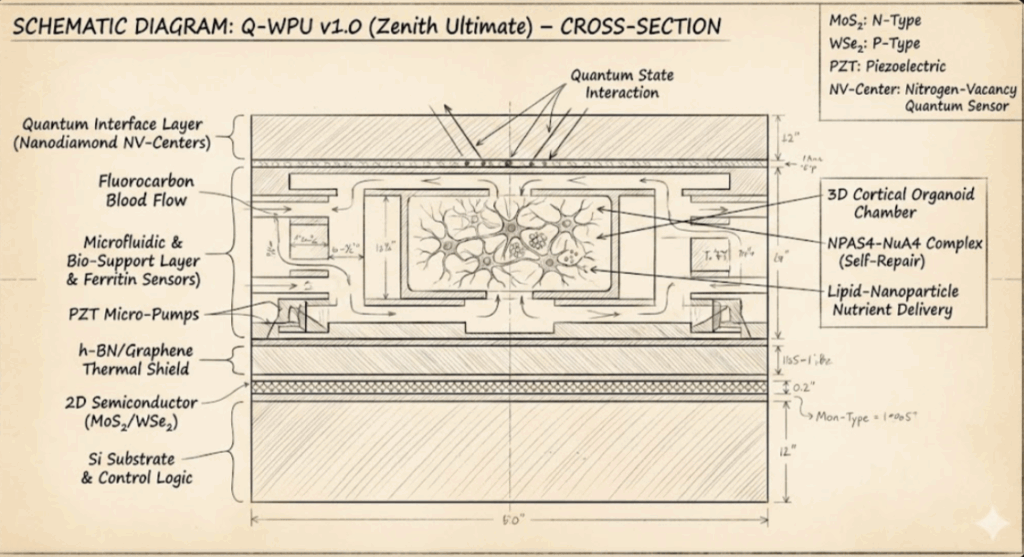
*Disclaimer: Content in the image above was AI generated(Thank you, Gemini 3 Pro) and information may not be distributed accurately.
I believe that such technology, if utilized properly, could change the world in ways such unimaginable by traditional human minds, but by such of a supercomputer.
Comments
One response to “Theoretical Cost-Efficient Bio-Quantum-Supercomputer”
Bots not welcome.
But did you know that I once made my own python discord bot?
Well now you do!

Leave a Reply