Your cart is currently empty!
Theoretical Electical-“Time Reflection” Computer Architecture(TR-EPU)
Typical Transistor logic consists of data known as bits, often written as 0 and 1.
For context, this design will be based on the paper written recently on researchers managing to time-reverse an electrical wave.
You can check the paper out here or here or the news release here.
I will call this by Time-Reversed-Electrical Processing Unit(TR-EPU)
Instead of standard electrical gates, this chip utilizes Temporal Interfaces. These interfaces flip the medium’s impedance to reverse waves, allowing a single wave packet to carry over 200 states-far beyond the simple 0 and 1 of today. To keep these waves moving at maximum velocity, 2D Bismuth-based (Bi-O-Se) transistors provide near-zero resistance.
Precision is key. A specialized Star-Topology wiring system ensures every “switch” command travels the exact same distance, allowing the entire chip to “time-reflect” at the exact same nanosecond. To power these flips, Gallium Nitride (GaN) and Indium Phosphide (InP) switches provide Terahertz (THz) speeds for near-instant switching.
Heat has been a reoccuring encounter in many chip types.
We attempt to resolve this issue by the implementation of a Borosilicate Glass base embedded with Synthetic Diamond Nano-Dust in high-heat zones.
Two-Phase Dielectric Immersion Cooling combined with Vertical Diamond Thermal Pillars will be deployed to pull heat away from the chip’s core.
Capacitors can be used for applications requiring sudden bursts of energy. Such is required for design, but size requirments are not appropriate for production, meaning costs will increase dramatically if a traditional large capacitor was used here.
We can instead provide Graphene-based Hybrid Supercapacitors as these provide the appropriate burst needed to flip the time interface instantly without draining the standard battery.
Data will be stored as trapped loops of light/waves, meaning the “RAM” is as fast as the processor.
Bismuth layers allow the data to be processed while it is in the memory, removing the slow “data travel” time found in regular PCs.
Here is a diagram of how such a chip would look:
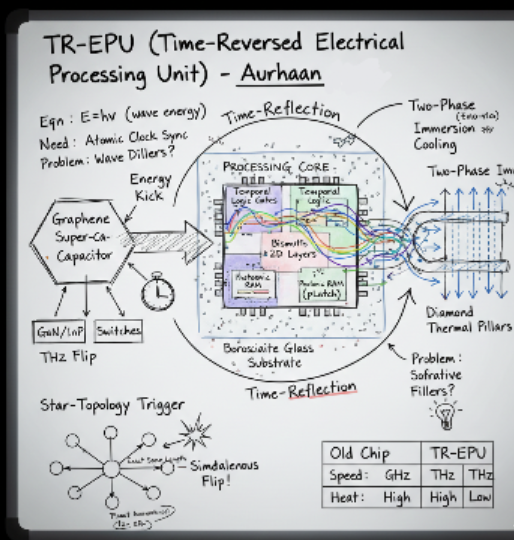
*Disclaimer: The content in the image above was created by generative AI and may incorporate details as such.
This diagram was created for informational purpouses only.
Such a computer could theoretically improve the AI innovations created currently by measures.
Leave a Reply