I will reveal a stunning AI benchmark which was found by yours truly, I am quite astonished that not a single AI including ChatGPT-5.4 Thinking, ChatGPT 5.2 Thinking, Gemini 3 Pro, Perplexity Sonar, and more could solve the problem.
Want to know what this “unsolvable problem” is?
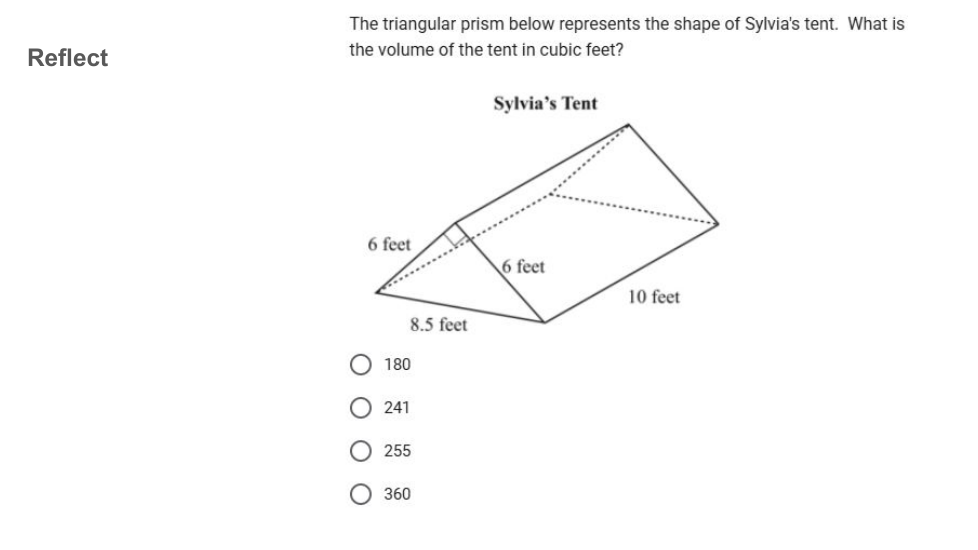
Feast your eyes:
I believe that the answer is A. 180 because the height is not given.
So we can see the isosceles base has an area equivalent to (6*6)/2=18.
So for the past few days, I have been staying at a particular Airbnb with my family and 2 others.
For related contextual purposes, this place had a garage with the largest ping pong table I had seen in my life.
So me, my brother(check him out at aurique.ullasdas.com) and this 6-year-old(his name is Audhrit) that was with us, went down there.
Then the door locked behind us, my observations indicated that the 6-year-old did such actions, but he claims otherwise.
I shouted as loud as my oral cavity could manage, “HELLPPP”.
So did the others.
NO. RESPONSE.
Now we started getting terrified(not Audhrit, he’s chill like that).
Then, I started tinkering with the garage door and stumbled upon…
AN OPEN DOGGY DOOR!
We would be saved, but I wonder, who is small enough to go through the thing?
Audrith, of course!
And he fit perfectly.
Then he told his parents(and possibly everyone else) and we were free!
Now, my dad claims that he heard the screams, but let it off as us “playing”.
And by the way, Audrith is actually pretty smart, he was actually EAGER to learn math from me, I actually taught him of equations yesterday.
Also, he has a huge obsession(and fear) with mushrooms.
For the intellectual individuals who desire to receive updates on my scientific journey, I am currently in the process of publishing my paper to Medical Hypotheses, specifically this one, from Zendo.
Yesterday, I went to the MATHCOUNTS competition and in the middle of lunch, this random tall girl approaches me with a slightly smaller girl by her side.
Then the taller one goes with a smile and delivers this monster of a line:
“Can I have your number?”
I immediately fall silent, and without thinking twice, go:
“I DOn’t HAVe A PErSONAL NUMbeR.”
I clearly neglected the subtle fact that I know my parents’ phone number, and I could have provided that to her.
The part which traumatized me the most was that she was significantly taller than me, which likely signifies she is OLDER than me….
She then left, clearly sad with her little moral support, slightly shorter buddy.
Such a technology, which possesses the ability to go through solids and retract with no damage to the solid is portrayed as a science fiction fantasy.
But such could theoretically become a reality with extensions of modern technology.
To execute penetration through a solid appropriately, we must deal with the fact that two things are unable occupy the same space at the same time. However, solids are not considered 100% solid. At the atomic level, there exists a large magnitude of empty space called interstitial voids.
The solid will not be melted with heat, but with the utilization of Terahertz Nano-Actuators to vibrate the solid’s atoms at incredibly high speeds. This vibration temporarily pushes the atoms into those empty microscopic gaps. For a brief moment, the solid acts like a high-density liquid right around the glove, allowing the user to penetrate through.
In the inclusion of the consideration of biological safety, considering that the solid may likely consist of a mixture in the user’s hand, the glove will release magnetic autonomous nano-carriers to create a physical “slip-layer” between the skin and the solid.
The solid may face the dilemma of mass displacement; such an issue must be resolved for proper efficiency. The glove will introduce compatibility with an AI which calculates the exact empty spaces in the material and shoves the atoms into those gaps.
The user may also face internal hazards, such as an electrical wire shocks which can be experienced inside the wall. This can be solved easily; the base layer of the glove will use industrial insulating rubber to block high voltage.
The glove may also face acoustic issues. As the glove goes through the wall, high-speed vibrations can create loud, deafening hums. This can be solved with graphene foam, which is a layer of advanced acoustic foam traps and absorbs the sound waves, keeping the process silent.
When the user retracts their arm, a high-power electromagnet in the cuff activates. This will instantly suck all the magnetic SQSM Mist back into the glove so it can be recycled for the next use. At the exact same time, the glove’s AI will slowly reduce the vibration frequency. This will allow the wall’s atoms to move out of the microscopic voids and snap back into their original grid layout.
The entry point heals instantly. The paint, brick, or metal will look almost exactly the same as it did before, and the building will lose none of its strength.
Here is a rough draft video depicting the potential promises of this discovery(Thank you Veo 3.1):
The physics behind it relies on real science. By understanding atomic structures, magnetic recovery, and acoustic dampening, we can turn impossible ideas into blueprints for the future.
Typical Transistor logic consists of data known as bits, often written as 0 and 1.
For context, this design will be based on the paper written recently on researchers managing to time-reverse an electrical wave.
You can check the paper out here or here or the news release here.
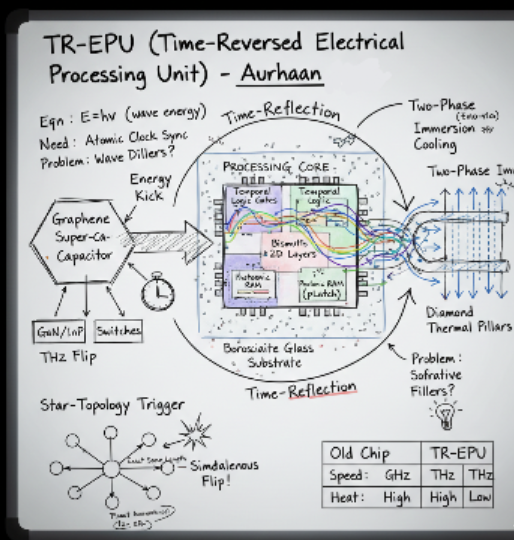
I will call this by Time-Reversed-Electrical Processing Unit(TR-EPU)
Instead of standard electrical gates, this chip utilizes Temporal Interfaces. These interfaces flip the medium’s impedance to reverse waves, allowing a single wave packet to carry over 200 states-far beyond the simple 0 and 1 of today. To keep these waves moving at maximum velocity, 2D Bismuth-based (Bi-O-Se) transistors provide near-zero resistance.
Precision is key. A specialized Star-Topology wiring system ensures every “switch” command travels the exact same distance, allowing the entire chip to “time-reflect” at the exact same nanosecond. To power these flips, Gallium Nitride (GaN) and Indium Phosphide (InP) switches provide Terahertz (THz) speeds for near-instant switching.
Heat has been a reoccuring encounter in many chip types. We attempt to resolve this issue by the implementation of a Borosilicate Glass base embedded with Synthetic Diamond Nano-Dust in high-heat zones. Two-Phase Dielectric Immersion Cooling combined with Vertical Diamond Thermal Pillars will be deployed to pull heat away from the chip’s core.
Capacitors can be used for applications requiring sudden bursts of energy. Such is required for design, but size requirments are not appropriate for production, meaning costs will increase dramatically if a traditional large capacitor was used here. We can instead provide Graphene-based Hybrid Supercapacitors as these provide the appropriate burst needed to flip the time interface instantly without draining the standard battery.
Data will be stored as trapped loops of light/waves, meaning the “RAM” is as fast as the processor. Bismuth layers allow the data to be processed while it is in the memory, removing the slow “data travel” time found in regular PCs.
Here is a diagram of how such a chip would look:
*Disclaimer: The content in the image above was created by generative AI and may incorporate details as such. This diagram was created for informational purpouses only.
Such a computer could theoretically improve the AI innovations created currently by measures.
The human brain remains the most sophisticated computational architecture in the known universe, yet we treat it as a biological curiosity rather than a blueprint for the future of processing. I am informed of those who imagine such wetware that can beat even Tensor Processing Unit(TPU) standards.
While current ‘DishBrain’ experiments have mastered basic tasks like Pong, we are barely scratching the surface of what biological logic can achieve when fused with modern material science.
I think that creating wetware, with standards not only above CPUs, not only above GPUs, not only above TPUs, but above QPUs.
So buckle up, for such a computer can come true soon(I can’t guarantee 2-3 years because of humans, with our powerful brains, we come up with reasons to take “short” breaks and procrastinate, so I have to say a broad thing, 30-40 years, there!).
We will introduce this as a Q-WPU, a Quatum-Wetware Processing Unit.
Let’s begin:
For contextual purposes, this is an extension of wetware.
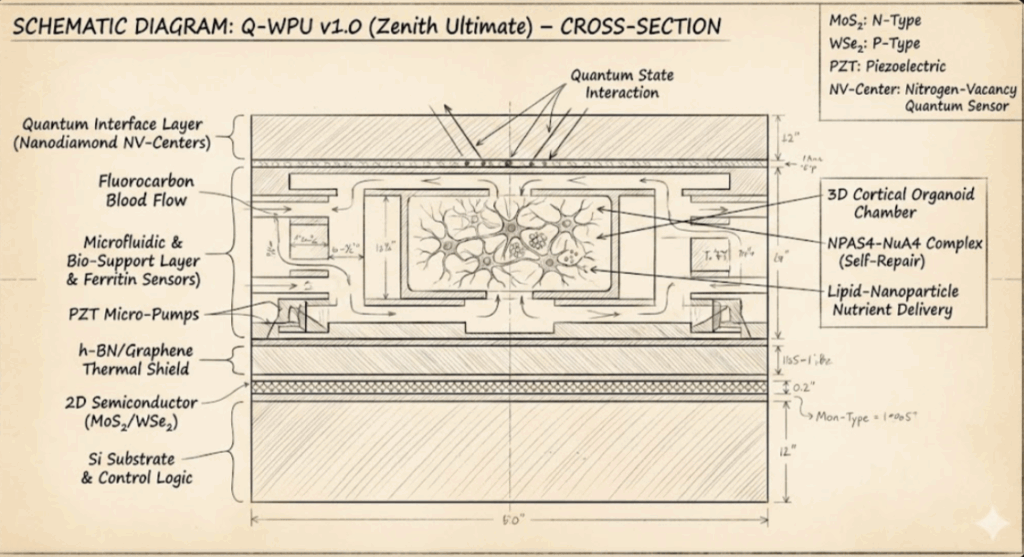
Transistors are quite useful parts, but their limitations are largely responsible for GPU extension limits due to transistor size constraints, and they exhibit sensitivity to heat and voltage spikes. This bio-computer will utilize Ambipolar transistors. This will incorporate Molybdenum Disulfide as the N-type channel and Tungsten Diselenide as the P-type channel. These 2D materials allow for atomic-scale thinness, drastically reducing electron scattering and heat generation.
A single atomic layer of Hexagonal Boron Nitride (h-BN) can provide a superior electrical insulation while allowing thermal energy to pass into the Graphene heat-sink layer, preventing biological “cooking.”
PZT (Lead Zirconate Titanate) micro-pumps will be deposited via Chemical Liquid Deposition (CLD), which will eliminate points of mechanical failure by using piezoelectric vibrations to circulate nutrients.
Fluorocarbon-Based Artificial Blood provides 20x the oxygen-carrying capacity of water-based systems, which enables high-frequency neural firing. And Lipid-Encapsulated Nanoparticles will contain a steady-state mix of Glucose and Magnesium L-Threonate for optimal synaptic plasticity.
3D-stacked cortical organoids, bio-engineered via CRISPR-Cas9 can be utilized to overexpress the NPAS4–NuA4 complex for continuous DNA self-repair during high-intensity calculation.
Quatum computers are considered a primary choice for high quality calculations and simulations, but a major barrier is cost. Ferritin-based molecular sensors can be engineered into the neural cytoskeleton to allow the neurons to interact directly with quantum states in the nanodiamond array without external laser observation.
The Q-WPU features a specific set of neurons(let’s call these “Construct Neurons”) programmed to synthesize biopolymers and mineralize metallic ions. This allows the WPU to:
Increase its own synaptic density in response to complex research tasks.
Repair microscopic hardware degradation in the fluidic channels.
Evolve its own architecture to optimize for specific AI models over time.
Coding such a supercomputer can be achieved with Temporal Coding, unlike binary due to a barrier in the typical neuron’s capability to understand coding languages such as C++ or Python. Such “code” for Spiking Neural Patterns(SNP)can be done by sending timed electrical pulses; the meaning of the pulses depends on the spacing of the pulses. We can utilize the Cello coding language, or a similar one, for the code of the Construct Neurons. The Cello code can be simply uploaded using by injecting a viral vector into the nutrient fluid.
For the quantum logic, code can be implemented using a future version of a coding language such as Qiskit which is required to be able to properly communicate with Nanodiamond sensors. The neurons will explore millions of quantum possibilities simultaneously and “settle” on the most efficient answer. This is commonly known as Reservoir Computing. The SNP can be represented as such, for example:
# TASK: Initialize "Research Mode" in the Cortical Lobe
# Format: [Frequency in Hz, Pulse Width in ms, Amplitude in mV]

SIGNAL_START = [40Hz, 2.5ms, 150mV]
# Gamma rhythm to "wake up" the neurons
SIGNAL_DATA  = [||  |  |||  |  ||]
# The actual data encoded as spikes
SIGNAL_SYNC  = [100Hz, 0.5ms, 50mV]
# High-frequency "clock" signal
The Cello code for the Construct Neurons, an example, in Verilog:
// FILE: build_memory.cell
// PURPOSE: Tell "Construction Neurons" to build Ferritin sensors
module MemoryGrow(input wire PatternDetected, output wire BuildFerritin);
  // Biological Logic Gate: If Pattern is     detected AND Energy is high
  assign BuildFerritin = PatternDetected & EnergyHigh;
  // Physical Constraint: Only grow if Fluorocarbon oxygen is > 80%
  gate pConst_Oxygen(.in(OxygenLevel), .out(EnergyHigh));

endmodule
The “User Interface” will handle entanglement and biological rewards, using Python:
import zenith_qwpu as qwpu

# 1. Connect to the Zenit Public v1.0 Chip
brain = qwpu.connect(device_id="WPU-001")

# 2. Define a Quantum Superposition Task using Nanodiamond NV-Centers.
with brain.quantum_session() as q_space:
    # We don't solve the math; we let the       neurons "feel" the state
    search_pattern = q_space.superposition(data_stream="Cancer_Protein_Fold")
    # 3. Send the pattern to the Organoid via Optogenetic light pulses
    brain.stimulate_optically(pattern=search_pattern, intensity=0.8)
# 4. Check for "Biological Consensus" (Wait for Synchronized Bursts)
result = brain.wait_for_synaptic_firing(consensus_threshold=0.95)
# 5. Provide "Dopamine-Juice" Reward if result is accurate
if result.accuracy > 0.99:
    brain.release_reward_ligand(dose="2.0ml")
    print(f"Success! Result found in     {result.latency}ms")
To understand why the Q-WPU is a breakthrough, we must look at the energy cost per operation ($E_{op}$). Current silicon GPUs are limited by the Landauer limit and thermal noise, whereas biological neurons operate near the physical limits of thermodynamic efficiency.
A top-tier silicon GPU requires approximately 700 Watts to achieve 1 Petaflop ($$10^{15}$$ operations per second).
The human brain, the blueprint for the Q-WPU, requires only 20 Watts to achieve an estimated 10 Petaflops ($$10^{16}$$ operations per second).
We can calculate the efficiency ratio ($$\eta$$) as:
Conclusion: The Q-WPU is mathematically 350 times more efficient than the best silicon hardware available in 2026.
The Q-WPU does not just “calculate”; it “perceives” solutions. Because of the Reservoir Computing model and native quantum superposition, the Q-WPU is uniquely suited for tasks that are currently “computationally expensive” for traditional supercomputers:
While a traditional GPU takes weeks to simulate how a protein folds, the Q-WPU’s neurons can “feel” the most stable molecular state in milliseconds using quantum sensing. This could help solve diseases like Alzheimer’s in a fraction of the time.
Standard weather models struggle with “chaos theory.” The Q-WPU uses its biological plasticity to adapt to chaotic data, allowing for $99\%$ accurate weather predictions down to the specific city block.
Because the Construct Neurons can physically change the chip’s architecture, the Q-WPU can “grow” new hardware defenses the moment it detects a new type of digital threat, making it the first truly unhackable system.
Here is a table of the metric comparisons of an NVIDIA B200 with the Q-WPU v1.0
Metric
Traditional GPU (NVIDIA B200)
Q-WPUv1.0
Logic Processing
$$4\text{nm}$$ Silicon (Static)
$$MoS_{2}$$/$$WSe_{2}$$ (Dynamic)
Energy Input
$$\sim 700\text{W}$$ (High Heat)
$$\sim 25\text{W}$$ (Room Temp)
Logic Density
Fixed Silicon Gates
Dynamic Synaptic Growth
Error Handling
Digital Parity Checks
Biological Self-Repair ($$NPAS4$$)
Quantum State
Simulated (Slow)
Native (Nanodiamond NV-Centers)
Architecture
Static / Fixed
Self-Manufacturing / Evolvable
Here is a diagram of the Q-WPU v1.0:
*Disclaimer: Content in the image above was AI generated(Thank you, Gemini 3 Pro) and information may not be distributed accurately.
I believe that such technology, if utilized properly, could change the world in ways such unimaginable by traditional human minds, but by such of a supercomputer.
Hehe, I’m 12yrs old now.
I’m going to the A&T lab today(idk which one) because my dad got contact with someone who works there and I get to go for FREE.
I have a conceptual innovation to restore memories and modulate them extendedly.
This will incorporate synaptic autonomous nanocarriers, these nanocarriers will be powered by traditional power the body receives, glucose.
This will work via a Glucose-Biofuel Cell, which will convert glucose sugars into electrical energy.
Memory Modulation and Eventual Disposal
Memory modulation will work by incorporating the nanocarriers.
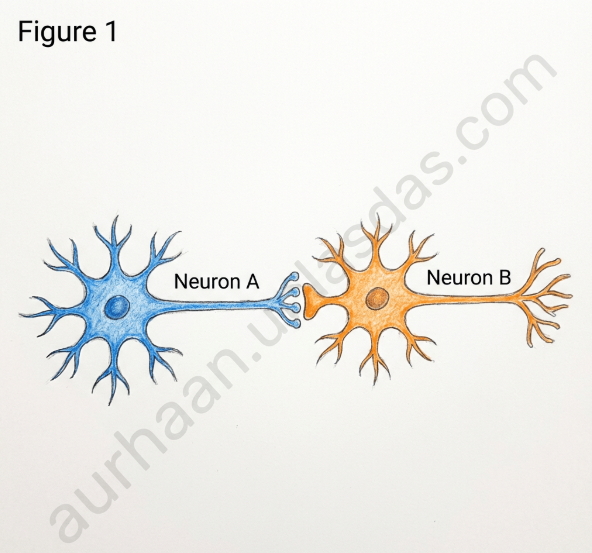
We will assume there is a connection between Neuron A and Neuron B as shown in Figure 1.
The patient is asked to think about the bad experience vividly to expose the neurons which store the bad experience. We can utilize Long-Term Depression(LTD).
Neuron A releases Glutamate. It floats across and hits Receptors on Neuron B. The nanocarrier releases enzymes that break down the Glutamate before it reaches the other side. The message is intercepted, after experiencing this repeatedly in the target area, the Nervous system realizes that the connection is inappropriate and useless because the connection is not received by Neuron B, this will result in the connection being biologically dissolved.
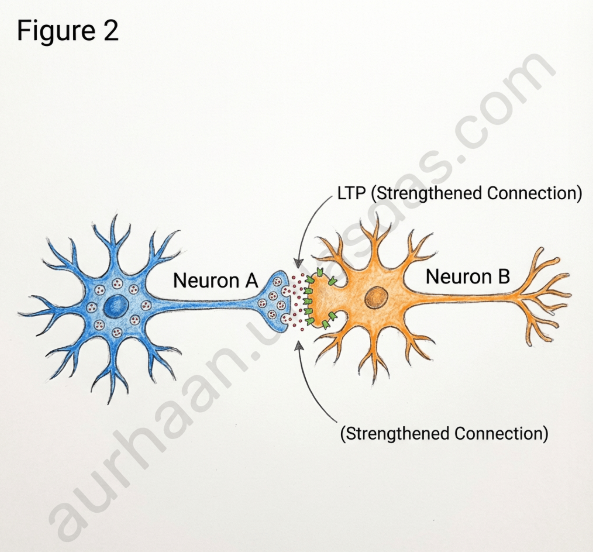
We will still keep Neuron A and Neuron B to present how we will integrate memory restoration into this design as shown in Figure 2.
We can utilize Long-Term Potentiation(LTP) by connecting the nanocarriers to a weak neuron connection(s) , whenever a weak signal from the damaged neuron(lets assume Neuron A, the signal is Glutamate) is received by the nanocarrier, using the glucose energy provided by digestion and daily consumption of nutrients, an internal capacitor of the nanocarrier will be powered, this capacitor will hold an electrical charge in reserve waiting from the signal from Neuron A, current options to amplify the faint signal from Neuron A is to release a concentrated dose of synthetic Glutamate directly onto Neuron B or extends a conductive probe to touch the membrane of the receiving neuron and delivers a calibrated micro-shock (millivolts), this artificial boost forces the receiving neuron’s voltage to depolarize, the nanocarrier produces and transmits the memory signal to Neuron B, and the memory signal continues down the line.
In this article, I propose a new way to build a quantum computer.
The most recent quantum chips are Majorana 1 by Microsoft and Willow by Google.
The proposed way to build a quantum computer is to combine a TPU(Tensor Processing Unit) and a Willow or Majorana 1 or any other type of quantum chip.
The problem with this design is temperature differences. The TPU runs on high temperatures, while the average quantum computer runs on ~-273° C, near absolute zero.
Luckily, there is a chip called SFQ-NPU(Single-Flux Quantum Neural Processing Unit). This chip can run in temperatures like those experienced by quantum computers.
So in theory, combining these chips will result in a single QPU-TPU chip.
A promising way to combine these chips into 1 is 3D Flip-Chip Bonding, this technique uses microscopic Indium Bumps to connect the chips together.
Since SFQ-NPU speaks in Digital(pulses), and the quantum chip speaks in Analog(waves), we can treat the SFQ-NPU like a Digital-to-Analog Converter (DAC). The SQU-NPU will fire its pulses rapidly and in some specific pattern that it’s waves will look like one specific wave.
There are no changes for the one writing the code! For example, to rotate a qubit in python, qubit.rotate_X().
Due to temperature requirements, the full SFQ-NPU-QPU chip will still unfortunately have to stay in a dilution refrigerator.
I hope that these changes will accelerate AI production speed and allow large-scale simulations and specific data to be found.